 Simulated setting
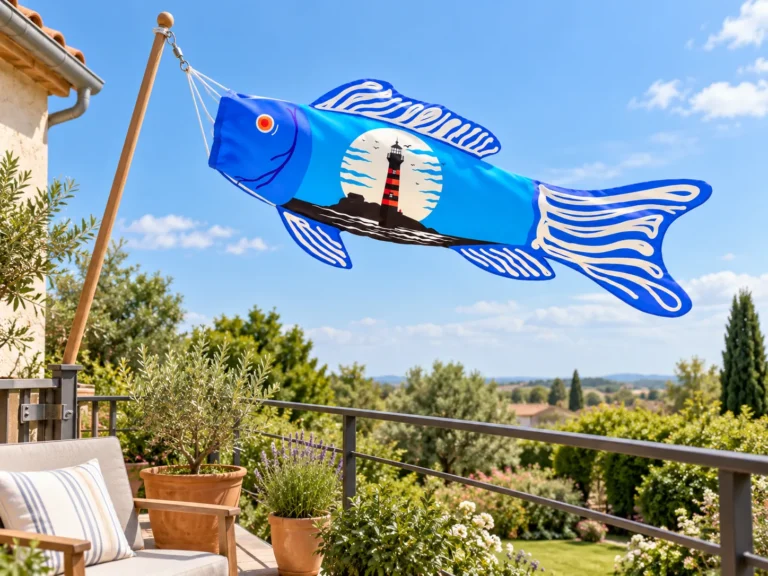
To decorate a garden with a koinobori, choose a drawing whose colours work with the landscape, then hang the carp where it can extend without obstruction. One may be quite enough. The wind contributes something fixed ornaments cannot offer: movement that is never exactly the same twice.
Why does movement make such a difference?
Gardens already move. Leaves tremble, shadows lengthen and ornamental grasses lean in the breeze. Yet most things we add, pots, benches or sculptures, stay where they are.
A koinobori behaves differently. At rest, its fabric hangs loosely. When the wind rises, the silhouette appears, the fins open and the drawing reaches its full length. The motif is therefore never presented in precisely the same way.
That small change can make us notice a familiar place afresh: the direction of the breeze, light falling behind the carp, a flash of red against dark leaves.
Should its colours match the garden?
Not necessarily. There are two approaches. You can look for continuity: blue near the sea, green among plants, softer shades against pale stone. Or you can choose contrast: a red carp before a white wall, a vivid pattern beside quiet grasses.
Catherine and I often step back from our drawings as we develop them. Some details look lovely on a screen but disappear when the carp is hanging in the air. The balance of broad colour areas matters more then than the fineness of every line.
There is no fixed rule for the right choice. You need to like the drawing, and the place must give it room.
One carp or several?
A large display can be extraordinary. In Japan, rows of koinobori crossing a river sometimes fill the sky with colour. The scale of a private garden is different.
In a courtyard or small garden, one carp may be enough to hold the eye. In a larger space, several can create a rhythm, provided there is room for movement and safe supports. Different lengths alone do not make a thoughtful arrangement.
I would start with one, live with it for a while and only then decide whether another really belongs there.
Which designs suit a coastal garden?
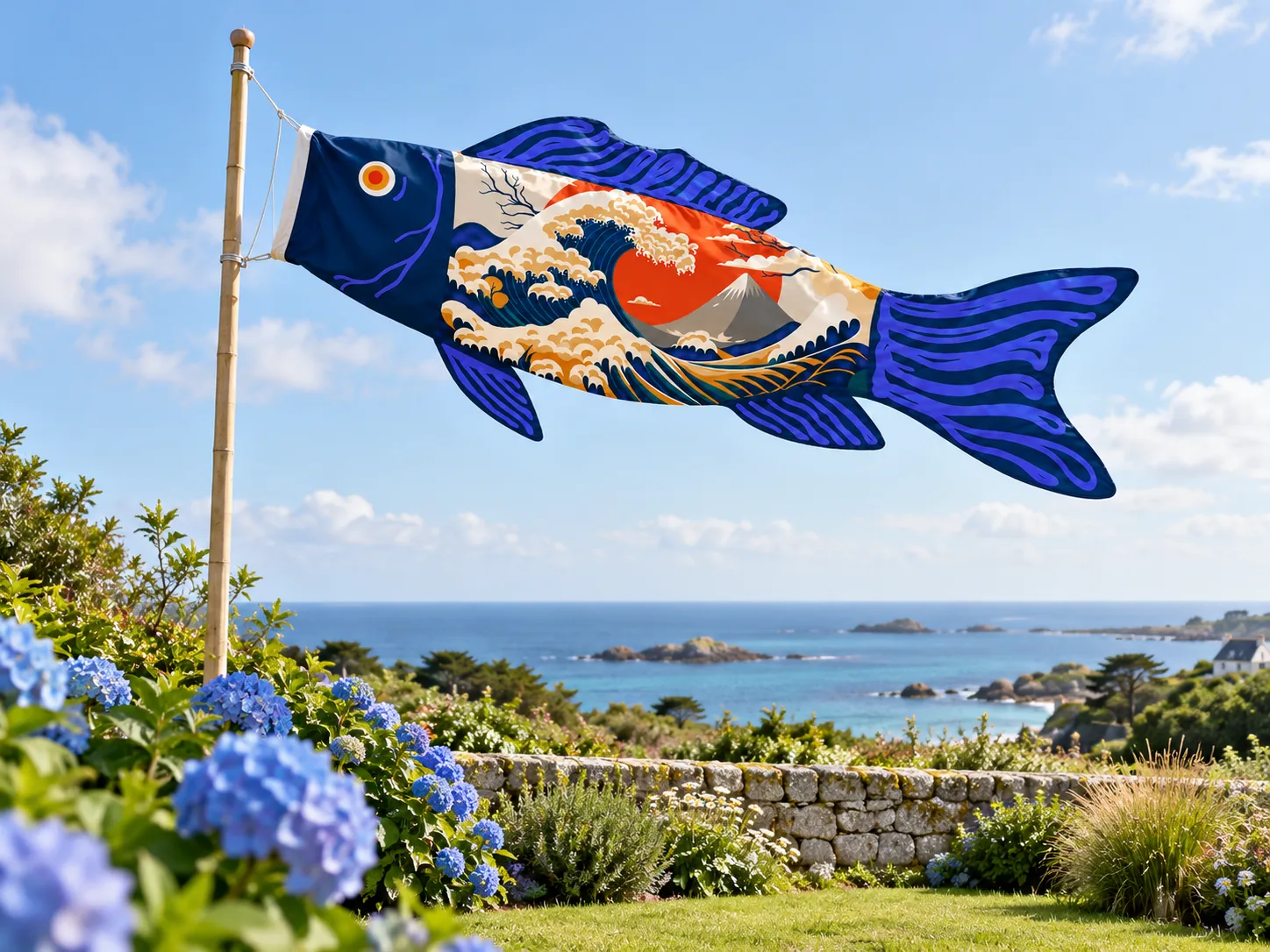
The coast offers its own palette: blue sky, changing green water, grey rocks and the brightness of foam. A wave pattern can sit naturally in such surroundings. A strong red carp might be a more unexpected choice.
Our Sea world explores these possibilities. La Vague Bleue, for instance, brings together a foaming wave, a red sun and a snow-capped mountain. The drawing recalls Japanese woodblock prints, but changes character when adapted to the long silhouette of a koinobori.
Be careful not to confuse an attractive setting with safe conditions. Coastal wind can be fierce. A beautiful position is no substitute for checking supports, attachments and the forecast.
Can floral patterns work outdoors?
Of course. A carp covered in flowers need not be hung beside a blossoming cherry tree. A plain wall or simple foliage may actually show the drawing more clearly than an already crowded flowerbed.
The Hanami world explores floral compositions. Unlike flowers growing in the garden, those on the fabric move with the carp. There is something pleasing in the meeting of a fish-shaped object and botanical motifs, without any need to reproduce a traditional Japanese setting.
The more geometric Patterns world can be equally at home beside contemporary architecture or a garden with restrained lines.
What about a minimalist garden?
Clear space often makes a drawing easier to enjoy. A pole, carefully chosen plants and an open patch of sky may be sufficient. Adding more could weaken the effect.
For us, this has something in common with the Japanese idea of ma, the interval or space between things. It is not a decorating formula. It simply means allowing one element to exist without crowding it with another.
A bold koinobori benefits from a quiet background. A heavily planted garden may call for a more restrained drawing. Look and compare before deciding.
Where will you enjoy seeing it every day?
View the garden from the house, the terrace table or the path you usually take. The best position is not necessarily central. A carp at the far end of a garden can draw the eye without dominating the space.
Check clearance, possible movement and secure fixing. Our guide How Do You Hang a Koinobori at Home? covers the practical considerations.
Once it is in place, leave it alone. Some days it will barely move. On others, it will seem almost impatient. That difference is part of its appeal.
Browse Sea and Hanami for a drawing that suits your garden.
More koi to discover
-
 Patterns
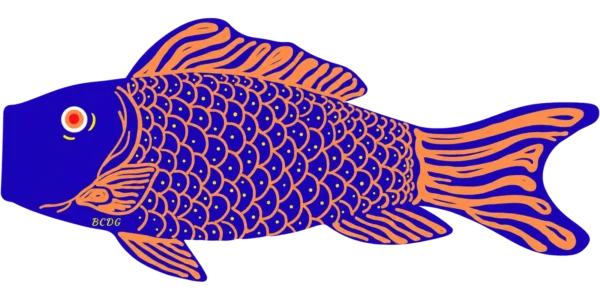
Écailles Bleues et Oranges
Price range: 24 € through 29 €Select options This product has multiple variants. The options may be chosen on the product page -
 Lands
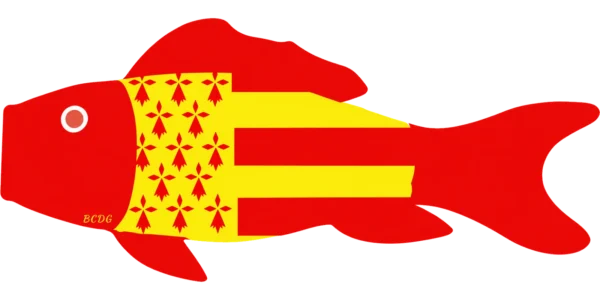
Bigouden
Price range: 20 € through 25 €Select options This product has multiple variants. The options may be chosen on the product page
Continue the journey
 Simulated setting
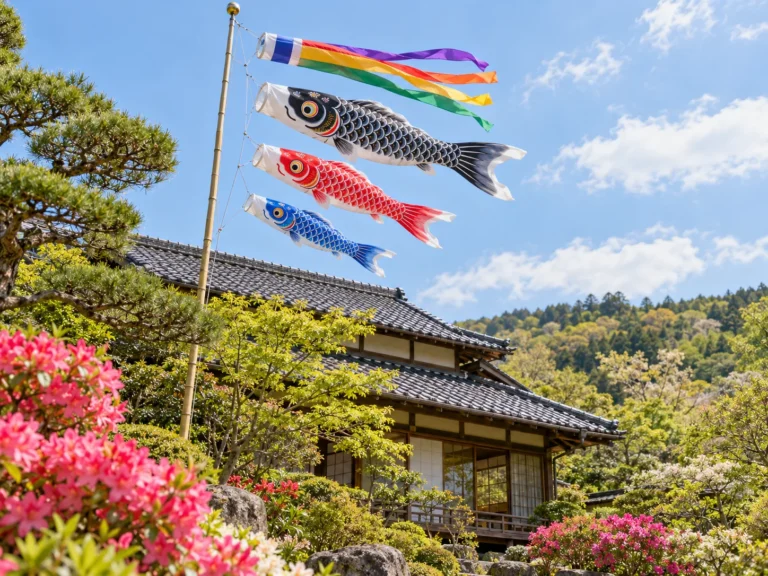
What Does a Koinobori Symbolise in Japan?
In Japan, a koinobori is a carp-shaped windsock traditionally flown in the weeks around 5 May, Children's Day, or Kodomo no Hi. The carp stands for courage, strength and perseverance. Families raise these streamers as an expression of hope: may…
 Simulated setting
How Do You Hang a Koinobori at Home?
To hang a koinobori, use a securely fixed support and leave enough room for the carp to extend and turn with the wind. A suitable pole often works well in a garden; on a balcony, a safe fixing point and…