 Simulated setting
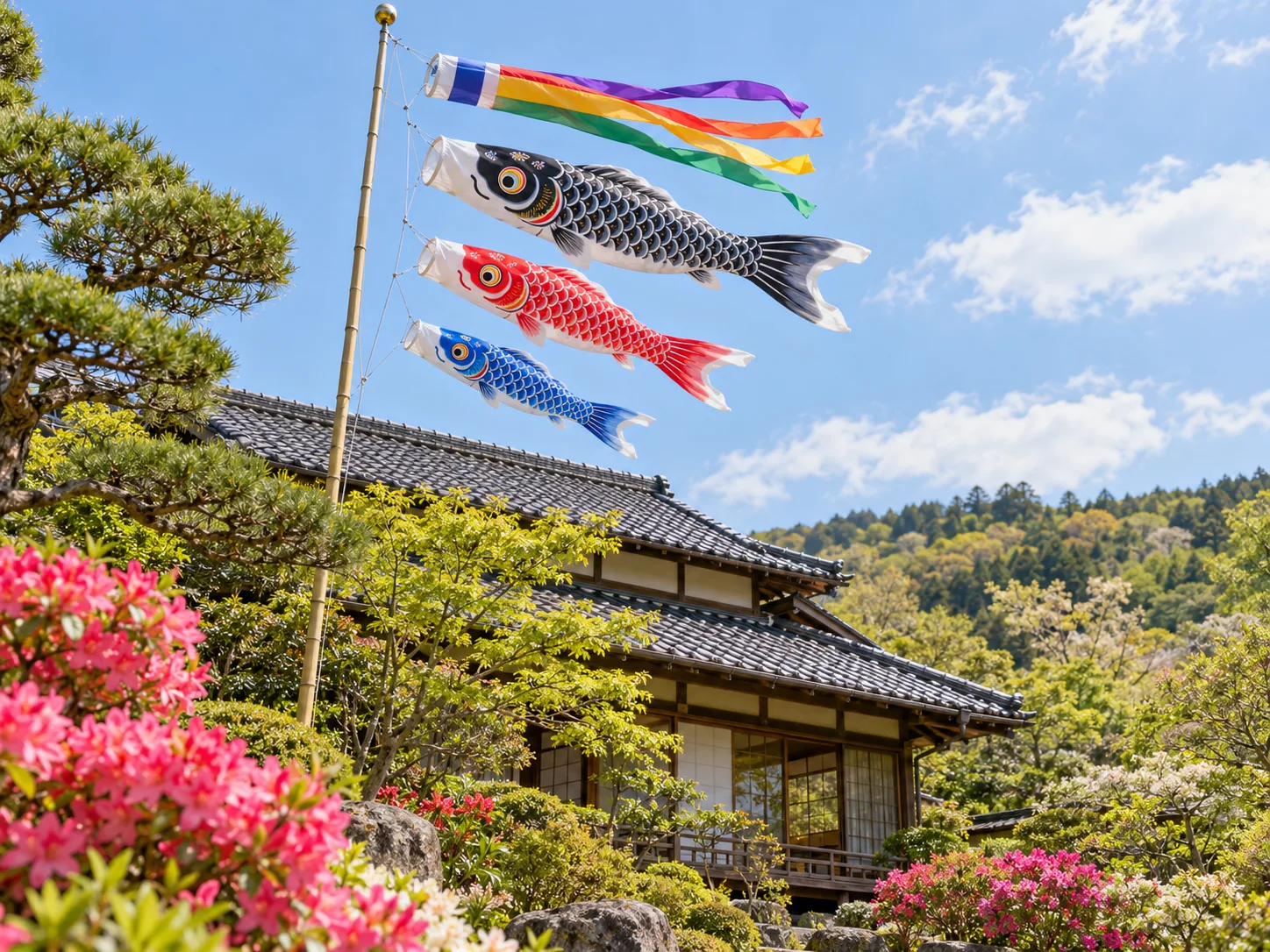
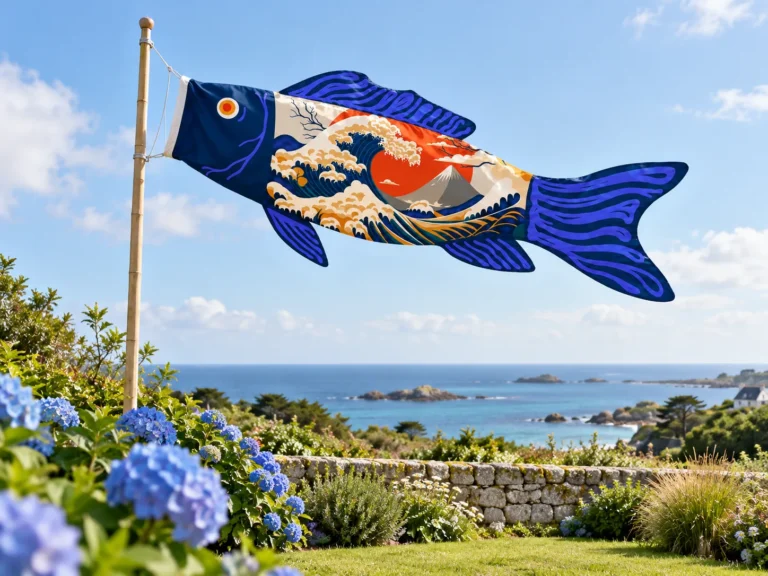
In Japan, a koinobori is a carp-shaped windsock traditionally flown in the weeks around 5 May, Children’s Day, or Kodomo no Hi. The carp stands for courage, strength and perseverance. Families raise these streamers as an expression of hope: may their children grow up able to face life’s difficulties.
Why a carp rather than another fish?
A carp can swim against a current. That, rather than any particular beauty, gave it a place in Japanese imagination. An old tale tells of a carp battling its way up a waterfall and becoming a dragon. In Japan, the story is associated with Tōryūmon, the Dragon Gate.
It is not a tale of effortless success. There is resistance, exhaustion and the decision to keep going. The carp, hanging above a family home, speaks of endurance rather than easy triumph. I find that a more moving wish for a child than the promise of a life without obstacles.
Why are koinobori flown on 5 May?
In Japan, 5 May is now a national holiday celebrating children. It developed from Tango no Sekku, a seasonal observance once closely associated with boys. In 1948, Kodomo no Hi became a public holiday celebrating children’s happiness and expressing gratitude towards mothers.
Families once raised banners and later fabric carp for their sons. The streamers remained part of the spring landscape. Today you can see them beside houses and gardens, and sometimes hundreds suspended across rivers. Their arrival marks the season as surely as certain blossoms.
Do the colours have fixed meanings?
In a family display, the large black carp commonly represents the father. The red carp has represented the eldest son in older arrangements and later the mother; other colours have been used for children. These conventions evolved. There is no single colour code that applies to every household and every period.
Today a designer may choose red because it responds well to blue, or because a floral composition calls for it. Colours need not stand for individual members of a family. They can express a landscape, a season or an idea. Understanding the tradition allows us to recognise where it ends and our own drawing begins.
How does a fabric carp fly?
The mouth of a koinobori is left open. Wind enters, fills the fabric body and extends it towards the tail. The fish turns with the breeze, its fins moving with the air. Without wind it hangs loosely; when the breeze returns, it seems to resume swimming.
That may be what first caught my attention as a child. A little fabric and a bamboo stick were enough to change the look of the sky. There was nothing to operate. You simply waited for the wind.
Why does the koinobori mean something to me personally?
As a child in Japan, I tied little koinobori to bamboo sticks. Japanese friends of my father had given them to me for Boys’ Day. I had no idea I would come back to those carp many years later.
Much later, judo at the Kodokan and a life lived across continents gave the carp’s courage and perseverance a more personal meaning; I tell that story in The Studio. When Catherine and I draw a new koinobori today, those early memories sometimes return of their own accord.
Can koinobori be enjoyed outside Japan?
Certainly. Respecting the cultural meaning of an object does not prevent it from finding a place in another landscape. A koinobori may fly in a garden in May or at another time of year, provided it is installed safely and the conditions suit it. Indoors, it can be suspended for the pleasure of looking at the drawing rather than watching it fly.
At BCDG, we retain the familiar carp silhouette and create the drawings it carries. They belong to five worlds: Sea, Patterns, Hanami, Kaïro and Lands. Our drawings bear our signature. Japan gives us the form; our drawings take their own direction.
The Sea world shows how many different landscapes can inhabit the same silhouette, and our guide explains how to hang a koinobori at home.
Alain
More koi to discover
-
 Hanami
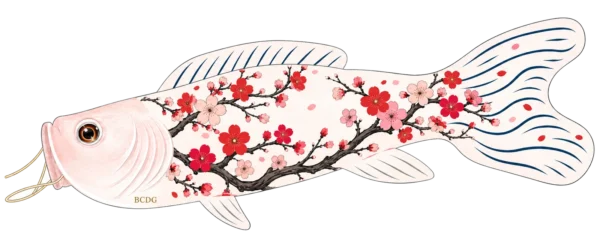
Sakura Rouge
Price range: 24 € through 29 €Select options This product has multiple variants. The options may be chosen on the product page -
 Lands
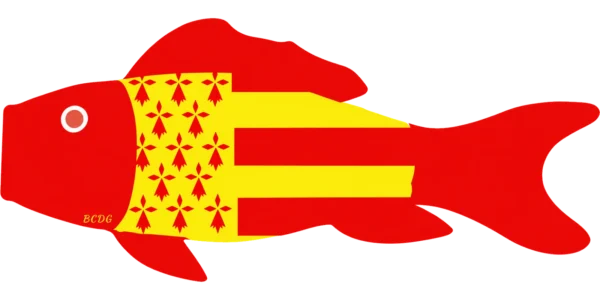
Bigouden
Price range: 20 € through 25 €Select options This product has multiple variants. The options may be chosen on the product page
Continue the journey
 Simulated setting
How Do You Hang a Koinobori at Home?
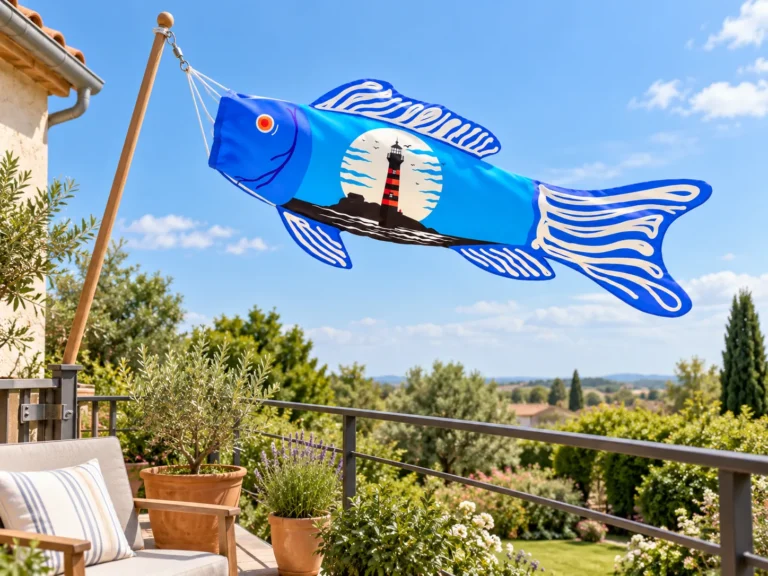
To hang a koinobori, use a securely fixed support and leave enough room for the carp to extend and turn with the wind. A suitable pole often works well in a garden; on a balcony, a safe fixing point and…
 Simulated setting
How Can Koinobori Decorate Your Garden?
To decorate a garden with a koinobori, choose a drawing whose colours work with the landscape, then hang the carp where it can extend without obstruction. One may be quite enough. The wind contributes something fixed ornaments cannot offer: movement…