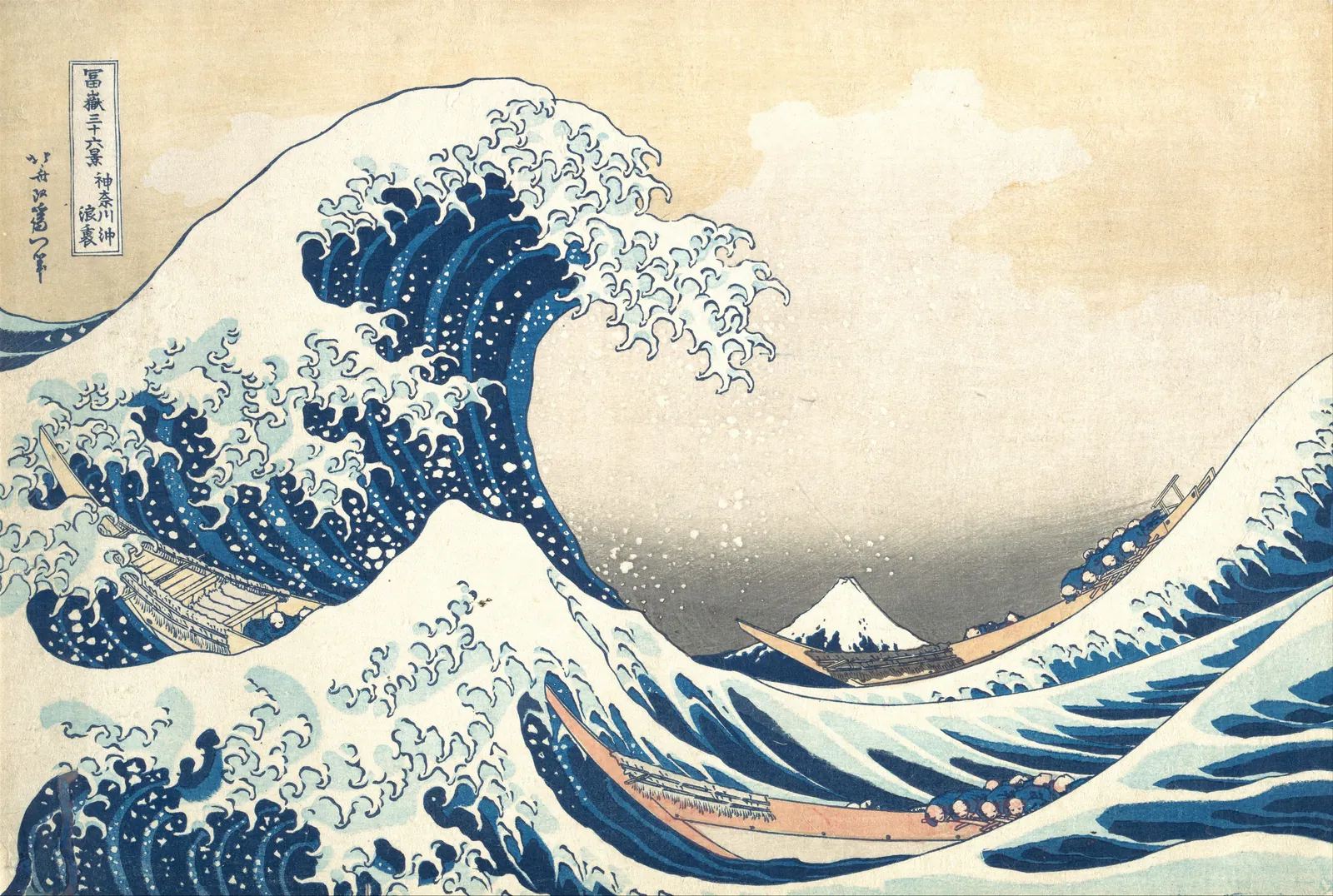
The Great Wave off Kanagawa is a woodblock print by Katsushika Hokusai, published around 1831 as part of his series Thirty-six Views of Mount Fuji. Its power lies partly in the composition: an enormous wave towers above small boats while Mount Fuji stands far away. The contrast between the restless sea and the mountain’s stillness has held viewers’ attention for generations.
What are we actually looking at?
We often think we know the image before we have really looked at it. A blue wave curls over, its crest breaking into sprays of foam. Three boats move through rough water. In the distance, between the waves, is a small triangular shape: Mount Fuji.
That detail matters. The mountain is the subject of Hokusai’s series, yet in this particular print it is almost overshadowed by the water. Japan’s great landmark seems surprisingly small, while the wave threatens to leap out of the picture.
Figures crouch in the boats, intent on their struggle with the sea. Art historians identify the vessels as fast boats used to carry goods, including fish, towards Edo. The print has a practical human world beneath its dramatic surface; it is not merely an imaginary seascape.
Does the print show a tsunami?
You may come across that description. Yet we cannot confidently treat the picture as a documentary image of a particular tsunami. The Japanese title, Kanagawa-oki nami-ura, is usually rendered as Under the Wave off Kanagawa. It does not identify a tsunami.
The picture’s force comes from something else: the difference in scale between the sea, the boats and the distant mountain; the sensation of a natural power far greater than the people below; and the continued presence of those people within it.
Great images tend to leave us with questions, even when we recognise their subject immediately.
When did Hokusai make The Great Wave?
The British Museum dates its publication to 1831. The Metropolitan Museum of Art gives the slightly broader date of approximately 1830–32. It belongs to Thirty-six Views of Mount Fuji, a series exploring the mountain from different positions and in changing landscapes.
Hokusai lived from 1760 to 1849. He was therefore an older artist when the print appeared, with decades of work behind him. The assurance of the composition is striking. The great wave is far more than an impressive effect: its curves and balance are almost geometrically precise.
This is a print produced from carved woodblocks, not an oil painting or a unique drawing. Multiple impressions survive, and specialists can identify differences between them caused by printing and wear.
Why is the blue so memorable?
Blue is central to the print’s character. The British Museum has studied the pigments in different impressions. Its research identifies Prussian blue, valued for its intensity, as well as indigo in outlines and darker passages.
But the image does not rely on one flat blue. Broad shapes, narrow lines and changing shades build the body of the water. White foam breaks the crest into smaller forms. There is a remarkable tension between the sweeping curve of the wave and the pointed fragments at its edge.
For anyone interested in drawing, the lesson is worth studying. An image can be unforgettable without being crowded with detail.
Why does Mount Fuji look so small?
Hokusai uses perspective with great intelligence. The enormous wave occupies the foreground; Fuji stands far away beneath the arch of its crest. The mountain’s outline almost echoes that of a smaller wave.
Your eye moves between the two. Their shapes speak to each other, though their scale is radically different. Moving water and an apparently immovable mountain coexist within the same picture.
Perhaps that is what strikes me most: how much force the artist suggests with so few elements. A few boats, a mountain and a wave. Nothing more was needed.
What has this to do with BCDG koinobori?
A Hokusai woodblock print and a koinobori are not the same kind of object. One is a printed image; the other is a fabric carp animated by the wind. We have no wish to confuse them.
Yet the idea of carrying a whole landscape within a drawing interests us. On La Vague Bleue, a foaming wave, a red sun and a snow-capped mountain occupy the body of a carp. It is an original BCDG composition inspired by the visual world of Japanese prints, not a reproduction of Hokusai’s work.
When the breeze comes, the actual movement of the koinobori adds something to the movement represented in the drawing. The result is unlike a framed print, as it should be.
Do you need to know Japanese art to enjoy The Great Wave?
Not at all. You may first see an enormous sea, fear for the people in the boats and notice little Fuji in the distance. That is already a way of looking. Learning about the period, the technique and the artist may enrich the experience later.
I am wary of explanations that claim to exhaust the meaning of a picture. The images we return to tend to keep something back. Look again, and you notice another detail.
For accurate images and historical records, see the collections of The Metropolitan Museum of Art and The British Museum. And if the composition speaks to you, our Sea world shows how Catherine and I approach waves, colour and landscapes in our own drawings.
Image: Katsushika Hokusai, Under the Wave off Kanagawa (The Great Wave), from the series Thirty-six Views of Mount Fuji, ca. 1830–32, The Metropolitan Museum of Art, H. O. Havemeyer Collection, public domain.
More koi to discover
-
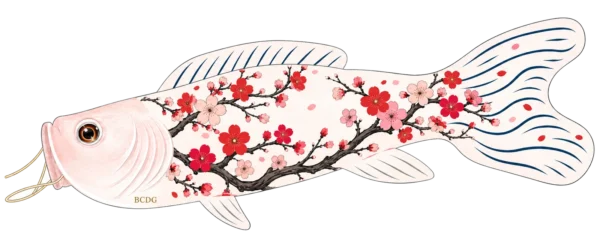 Hanami
Sakura Rouge
Price range: 24 € through 29 €Select options This product has multiple variants. The options may be chosen on the product page -
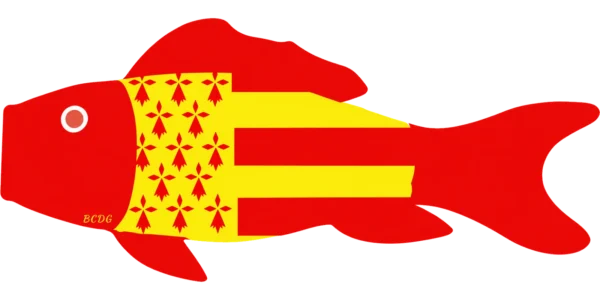 Lands
Bigouden
Price range: 20 € through 25 €Select options This product has multiple variants. The options may be chosen on the product page
Continue the journey
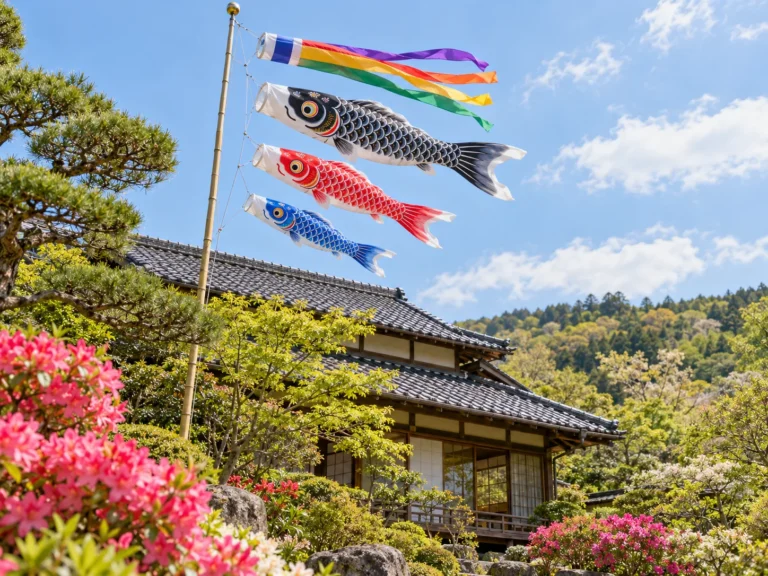 Simulated setting
What Does a Koinobori Symbolise in Japan?
In Japan, a koinobori is a carp-shaped windsock traditionally flown in the weeks around 5 May, Children's Day, or Kodomo no Hi. The carp stands for courage, strength and perseverance. Families raise these streamers as an expression of hope: may…
 Simulated setting
How Do You Hang a Koinobori at Home?
To hang a koinobori, use a securely fixed support and leave enough room for the carp to extend and turn with the wind. A suitable pole often works well in a garden; on a balcony, a safe fixing point and…